The Stories That Don't Fit on the Shelves

Photo Credit: SJ Bowen Photography
Source: SJ Bowen Photography – Original Photograph
The Beauty, Risks, and Human Cost of Serving in Public Libraries
By Magdianamy Carrillo Sotomayor, MLIS
Some people imagine public libraries as quiet places filled with shelves of books, where stories patiently wait to be discovered and librarians spend their days surrounded by literature. Throughout my career, I've heard the same comment countless times, and it never fails to make me smile: "It must be wonderful to work in a library and read books all day!"
Sometimes I wonder, with a touch of irony, whether they're referring to incident reports. Because after more than two decades working in libraries, I can say that some of the most unforgettable stories I've encountered were never written in the pages of a book.
They unfolded right before my eyes.
Public libraries are among the most extraordinary spaces in our communities. They are gateways to knowledge, sanctuaries for imagination, and places where intellectual freedom finds a home. Within their walls, a child can discover the universe through a story, an adult can learn to use a computer for the first time, and someone struggling with loneliness can find something as simple, yet essential, as a kind conversation.
But behind this beautiful image lies another reality, one rarely featured in our library promotional campaigns.
Libraries are also places where some of society's deepest wounds become visible. Poverty, homelessness, addiction, mental health crises, violence, and discrimination do not disappear when someone walks through our doors. Often, these struggles enter with them, along with the need for shelter, answers, opportunities, or simply someone willing to listen.
And there we are.
Librarians, library assistants, technicians, information specialists, and countless other public servants who chose a profession rooted in access to knowledge and service to others. Yet our responsibilities have expanded far beyond reference services, collection development, and promoting literacy.
Out of necessity, we have become conflict mediators, guides to social services, and sometimes the first people to respond to situations that threaten the physical or emotional safety of those around us. We learn de-escalation techniques, safety protocols, and emergency procedures, sometimes so frequently that we begin to wonder when preparing to respond to a crisis became as central to our work as preparing to inspire learning.
Not because we've stopped loving books, but because the human needs that enter our libraries are far more complex than anything even the most extraordinary collection can address on its own.
When the Story Is No Longer Fiction
Some experiences forever change the way we see our profession.
During my time working in New York, I experienced something I never imagined would happen inside a public library. A woman who had expressed hostility toward me because of my Puerto Rican accent, and who had previously been banned from the library, returned unexpectedly. As I sat at the information desk, she caught me off guard and pressed a kitchen knife against my neck.
At that same library, a man unexpectedly attacked one of my colleagues, striking her in the head so violently that she had to be taken to the emergency room.
Experiences like these leave scars that aren't always visible. Even after an incident ends, fear and vulnerability can linger long after the library doors have closed.
And yet, the next day, books must circulate again, computers must turn on, and the doors must reopen.
The community is waiting for us.
But who stops to ask how the person who faced a threat, responded to a crisis, or witnessed an act of violence the day before is doing emotionally?
In April 2019, Kelly Clark published a deeply moving article in American Libraries, the magazine of the American Library Association, titled Keep Library Workers Safe. In it, he shared the story of his wife, Amber Fawn Clark, a public library supervisor in Sacramento, California, who was murdered in December 2018 as she was preparing to drive home after work.
Her story raises a question that continues to echo throughout our profession: How can we defend spaces of access and dignity for everyone without also ensuring the safety of those who make that mission possible?
This is not about portraying libraries as dangerous places or associating poverty, mental illness, or addiction with violence. Doing so would be deeply unfair. It is about recognizing that honoring human dignity does not mean overlooking behaviors that put others at risk.
Compassion should never require us to sacrifice our own safety.
The Scars That Teach Us to Serve
Perhaps one of the most beautiful aspects of this profession is that many of us arrive carrying stories of our own. Some of us choose to serve because we know what it feels like to need help and not find it, to experience poverty or discrimination, or to feel invisible in a world that seems to keep moving without noticing those left behind.
For me, my commitment to access to information has roots far deeper than my academic education.
I remember arriving in downtown Rochester, New York, for the first time and needing to find a post office. What might have been a simple question for someone else felt like an overwhelming challenge to me. My English was limited, and the embarrassment of not being able to communicate confidently left me paralyzed.
I had grown up in Puerto Rico, an island deeply influenced by American culture, but my family's economic circumstances had not afforded me the same opportunities others had to learn and practice a second language. In the public housing community where I grew up, even attempting to speak English could make you the target of ridicule, as though learning another language meant turning your back on your roots.
Years later, I understood that my difficulty asking for directions was about much more than a language barrier. It carried the weight of inequality, limited opportunities, and the fear of being judged for not knowing something that seemed so simple to everyone else.
That's why, when someone comes into a library unsure how to complete a form, use a computer, look for a job, or communicate in a language they barely speak, I don't see just another reference question.
I see a human story.
I see someone who may be experiencing the same insecurity I once felt.
When I wrote Entre Letras y Cicatrices: Memorias de un Eslabón Perdido (Between Letters and Scars), I wanted to share more than a story of survival. I wanted to express a belief that has guided me throughout my life: Education can transform the course of a person's life.
And I don't mean only the education we receive in schools and universities. I mean the everyday learning that allows us to grow, discover opportunities, and become better human beings.
Libraries embody that possibility. They are places where knowledge is not reserved for those who can afford it, and where learning can become the first step toward a different future.
Perhaps that's why serving others can also be a deeply healing experience. There is something extraordinary about offering someone what we once needed so desperately ourselves: understanding, guidance, respect, or simply the reassurance that they have every right to be there.
But there is an important difference between finding meaning in service and believing we must save everyone.
Our wounds may teach us compassion, but they should never become an endless obligation to sacrifice ourselves for others.
The Paradox of Open Doors
Public libraries are among the few civic spaces where someone can walk in without having to purchase anything to justify their presence. That simple reality is one of the most powerful expressions of equity we still have as a society.
Yet it also creates a remarkable paradox: The more essential libraries become to people experiencing social inequality, the greater the demands placed on institutions whose resources may not always keep pace with the evolving needs of their communities.
When mental health services, affordable housing, treatment programs, and support networks are difficult to access, libraries often find themselves responding to needs that extend far beyond their traditional mission.
During my time leading Shute Park Library in Hillsboro, Oregon, I came to understand that some of the most difficult stories unfolding inside a library have nothing to do with books. I witnessed the weight of poverty, trauma, and social inequities through the lives of people seeking far more than information. There were moments that tested our resilience, challenged our sense of safety, and reminded us just how deeply the struggles of a community can reach those who serve it. Yet, within those same walls, I witnessed remarkable compassion, human connection, and the quiet power of second chances. Shute Park taught me that a library can be both a refuge for those seeking hope and a place where those offering it must also be cared for.
Library workers navigate these complex challenges with compassion, professional judgment, and a commitment to connecting people with the resources and opportunities available to them.
In December 2023, an audit of Multnomah County libraries in Oregon reported that only 27% of surveyed employees who interacted with the public in person felt safe at work. The survey responses, collected in November 2022, highlighted concerns about workplace violence, safety procedures, and the need for stronger coordination and support.
These findings offer an important opportunity for reflection and continued learning across our profession. They also remind us of the efforts already underway in many library systems, where leaders and employees are working together to strengthen safety practices, expand training, and build partnerships that respond to changing community needs.
Just as we recognize that firefighters, police officers, and emergency medical professionals may face danger while fulfilling their responsibilities, we must acknowledge that certain positions in public libraries also involve exposure to serious risks. Not because these professions are identical, but because the well-being of those who serve deserves thoughtful attention and meaningful support.
The dedication of library workers should be measured not by the risks they endure, but by the meaningful difference they make in the lives of others.
Compassion Needs Boundaries, Too
Over the years, I've come to understand that de-escalation is much more than a communication technique. It requires emotional awareness, active listening, respect, and the ability to recognize when a situation is no longer safe.
When training library workers, I emphasize three fundamental principles: safety, dignity, and access.
We can acknowledge someone's suffering without excusing their behavior. Show empathy without accepting threats. Set clear boundaries without humiliating anyone.
But no carefully chosen words can guarantee that a violent situation will be resolved through conversation. Knowing when to step away, ask for help, or activate an emergency response is just as important as knowing how to listen.
That is why I believe trauma-informed approaches are so valuable in public libraries, not only for understanding the experiences of the communities we serve, but also for recognizing the impact critical incidents can have on employees.
Ongoing training, clear protocols, partnerships with social workers and mental health professionals, appropriate safety resources, and meaningful post-incident support can help strengthen our ability to serve with both compassion and confidence.
Incident reports should be more than documents filed away. They can become valuable opportunities to identify patterns, learn from experiences, prevent future risks, and strengthen professional practices.
And while self-care remains essential, it becomes even more meaningful when supported by organizational practices that promote safety, well-being, and a sustainable culture of service.
Creating such environments requires ongoing communication, collaboration, and a shared commitment among library employees, leadership, community partners, and the institutions that support our work.
The Beauty That Blooms in the Darkness
Despite everything I have experienced and witnessed throughout my career, I continue to believe deeply in the transformative power of public libraries.
I've seen people discover new opportunities through access to information, families connect with resources they never knew existed, and individuals regain their confidence by learning a new skill.
These are the moments that remind us why we chose this profession.
Because even in circumstances that resemble a swamp of social struggles, extraordinary beauty can still bloom.
There are flowers that grow in difficult soil, lights that appear in the darkest tunnels, and small opportunities capable of changing the course of a life.
Libraries are part of that beauty.
But appreciating the flowers does not mean ignoring the conditions of the soil in which they grow.
If we want libraries to remain places of hope, we must collectively commit to sustaining them. That means recognizing the value of public investment, strengthening services, supporting employees, and building meaningful relationships with community organizations, educational institutions, healthcare providers, and social support networks.
Libraries cannot solve society's crises on their own. Nor should they be expected to.
Their greatest strength lies in connecting people with knowledge, opportunities, and one another. When communities, library professionals, organizational leaders, and public institutions work together, we create stronger networks of support and expand what is possible for those we serve.
Supporting libraries means supporting the people who make their mission possible.
Because Our Lives Matter, Too
We often speak of libraries as institutions capable of transforming lives. And I believe that with every fiber of my being.
Education transformed mine.
Access to knowledge allowed me to imagine possibilities that once seemed unreachable to the little girl who grew up surrounded by limitations and who, years later, could barely find the courage to ask for directions in a language she had yet to master.
Today, I still see libraries as places where hope takes tangible form: a library card, a completed job application, a book that arrives at just the right moment, or someone discovering that new opportunities are still within reach.
But I also know that behind each of those moments are library workers carrying their own stories, families, worries, and invisible scars. People who experience fear, exhaustion, and uncertainty. People who need support and deserve to return home safe and sound.
I don't want us to stop celebrating the beauty of public libraries. I want us to see them in their full complexity, acknowledging both their extraordinary contributions and the challenges that come with serving communities whose needs continue to evolve. Because advocating for libraries also means creating space for meaningful conversations about their most difficult realities.
In the end, perhaps the most important stories in a library are not always the ones carefully arranged on its shelves, but those written every day through the lives of the people who walk through its doors.
Stories of pain and hope. Of fear and courage. Of loss and new beginnings. Of human beings trying to help other human beings, even as they are still learning how to heal themselves.
And if we truly believe libraries have the power to save lives, then we must also protect the lives of those who make that mission possible.
Because no story of service should end in tragedy, and no calling should require us to lose our own humanity in order to preserve someone else's.
More Than Books: Why Libraries Matter
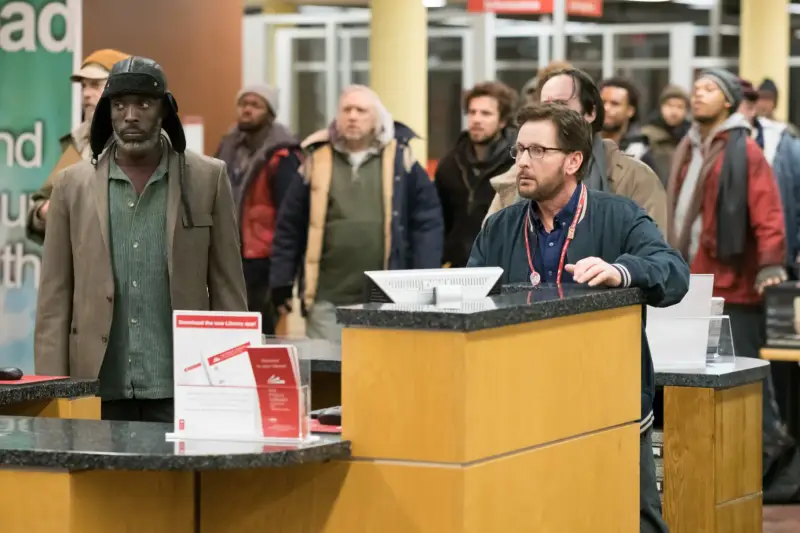
Photo: Brian Douglas / © Greenwich Entertainment. Scene from The Public (2018), directed by Emilio Estevez.
Fuente: Rotten Tomatoes – Photo Credits